

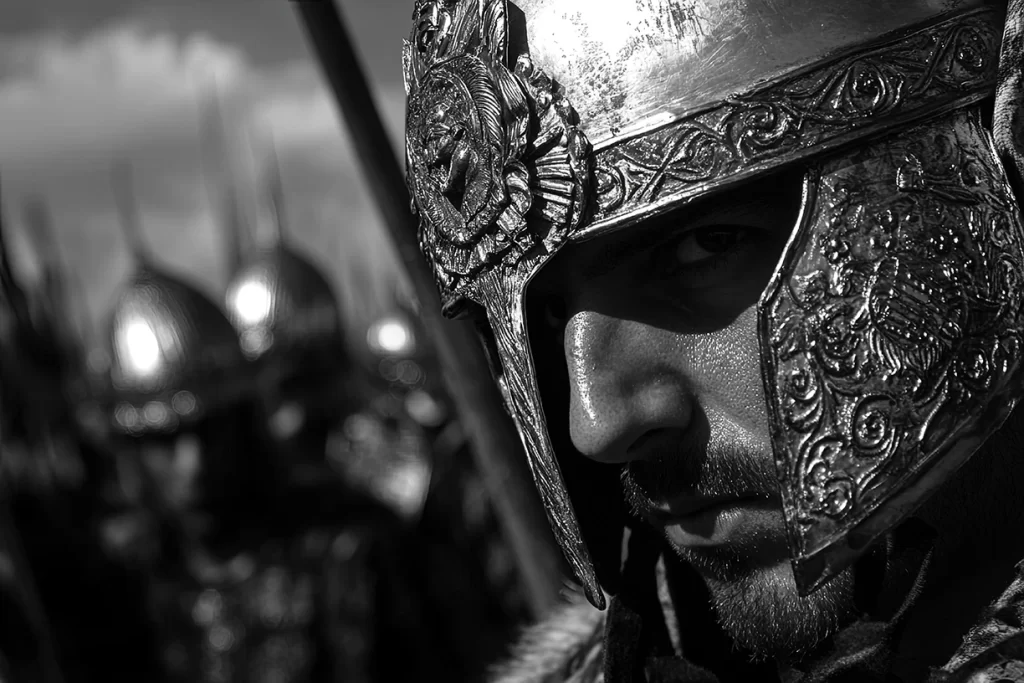
 The Romans, masters of the art of war and governance, bequeathed us valuable lessons on how strategy and tactics can sustain an empire. Their ability to adapt and continually improve their military tactics made them undisputed benchmarks in war techniques, achieving lasting success.
One of the most distinctive features that set them apart from other peoples was the incessant practice of training their soldiers, even in times of peace. This rigorous discipline was not a mere pastime, but a fundamental pillar for maintaining the readiness and effectiveness of their legions. As several historians point out, daily training was a constant, regardless of the existence of imminent conflicts. Julius Caesar, for example, attributed a large part of his victories to the discipline and continuous training of his troops [1]. A Disciplina Militaris was a central concept, ensuring that the legionaries were always prepared for any challenge, keeping their skills sharp and their cohesion as a unit [2].
It's not difficult to draw a parallel between this Roman philosophy and the business world. Just as the Romans understood that constant preparation was vital for the survival and expansion of their empire, today's companies need to recognize the importance of continuous training and adaptation in order to thrive in a constantly evolving market. What, after all, does 'training even when there is no war' mean in the business context?
In the corporate world, 'training even when there is no war' means proactively investing in talent development, innovation and continuous adaptation, even in periods of stability or boom. It's not just a question of training teams to deal with crises, but of fostering a culture of learning and constant improvement. This includes
- Continuous Skills Development: Ensure that employees are always up to date with the latest trends and technologies, not just when a new demand arises, but as an integral part of the company's routine. This can involve regular training, workshops and mentoring programs.
- Constant innovation: Don't wait for the competition to launch a disruptive product before you start innovating. Companies that thrive are always exploring new ideas, testing prototypes and looking for ways to improve their products and services, even if the current market seems satisfied. It's the mentality that 'what got us here won't get us there' [3].
- Analysis and Proactive Adaptation: Constantly monitoring the market, changes in consumer behavior and emerging technologies, anticipating challenges and opportunities. Instead of reacting to events, the company positions itself to shape the future, adjusting its strategies before the need becomes urgent.
Brand Strategy as Continuous Training
When we apply this concept to brand strategy, the analogy becomes even more pertinent. Building and maintaining a strong brand is not an isolated event, but a continuous process of 'training'. In times of 'peace' (when the brand is consolidated and the market stable), it is crucial to continue investing in:
- Consistency and Relevance: Keeping the brand message cohesive across all touchpoints and ensuring that it remains relevant to the target audience, even as their needs and values evolve. This requires continuous research and fine-tuning of communication.
- Customer Experience: Constantly improve the customer journey, from first contact to after-sales. A strong brand is built on positive and memorable experiences, and this requires a continuous effort to identify and resolve points of friction, even if customers aren't actively complaining.
- Brand Narrative: Reinforce and evolve the brand's story, ensuring that it resonates with the audience's aspirations and values. In a world where narratives quickly become obsolete, the ability to adapt and enrich the brand story is a competitive differentiator.
Just as the Romans understood that military discipline was the key to the longevity of their empire, companies that adopt the mentality of 'training even when there is no war' are building a solid foundation for resilience and long-term success. It's a guarantee that when the 'war' (a crisis, a new competitor, a market change) comes, their 'soldiers' (teams, products, brand) will not only be ready, but in top shape to win.
References
[1] Quora. What was the training of a Roman legionary like? Available at: https://pt.quora.com/Como-era-o-treinamento-de-um-legion%C3%A1rio-romano
[2] The Debate. The key to success behind the Roman legions. Available at: https://www.eldebate.com/historia/20230616/disciplina-militaris-clave-exito-legiones-romanas_121942.html
[3] Adapted from a popular quote in the business world, often attributed to Marshall Goldsmith or Peter Drucker, which emphasizes the need for continuous innovation.

 EN
EN  PT
PT  ES
ES