

With a clear purpose, it becomes the most powerful management tool for avoiding commoditization and aligning organizations.
Observing the market, it is possible to draw a powerful analogy with a vast and sometimes stormy ocean. Under a night sky, countless points of light flicker on the horizon. Most of them represent companies operating like boats - agile, fast, all sailing with one goal in mind: to reach a destination, to close deals, to find a safe harbor. They compete for routes, dodge storms and follow the currents. From a distance, their lights are almost indistinguishable from one another.
However, at strategic points along the coast, there are other lights. Fixed, powerful lights that don't move. They don't compete. They don't follow the currents. They are the reference. They are the beacons.
In the corporate world, this distinction is equally present. There are brands that behave like "boats" and those that establish themselves as "lighthouses".
What we notice is that many organizations are born with a light of their own, an intense flame that makes them unique. However, with the passage of time, growth, pressure for results and the need to navigate increasingly competitive waters, this light seems to diminish. The company becomes just another blinking dot in the immensity, competent and functional, but indistinguishable from so many others. It becomes, in fact, just another boat at sea.
This feeling that the original luster has been lost, that the brand has become a commodity, is one of the deepest and quietest pains that permeate the leadership environment. It's the perception that, despite all the effort and investment, the organization is being forced to compete more and more on price, and less and less on its intrinsic and unique value.
In this article, we will explore why this transformation is happening and how purpose, a concept that has been gaining prominence in strategic discussions, is the only tool capable of turning a boat into a lighthouse, guiding not only your customers, but your entire organizational structure.
The Symptom of Inconsistency: The True Cost of a Lack of Direction
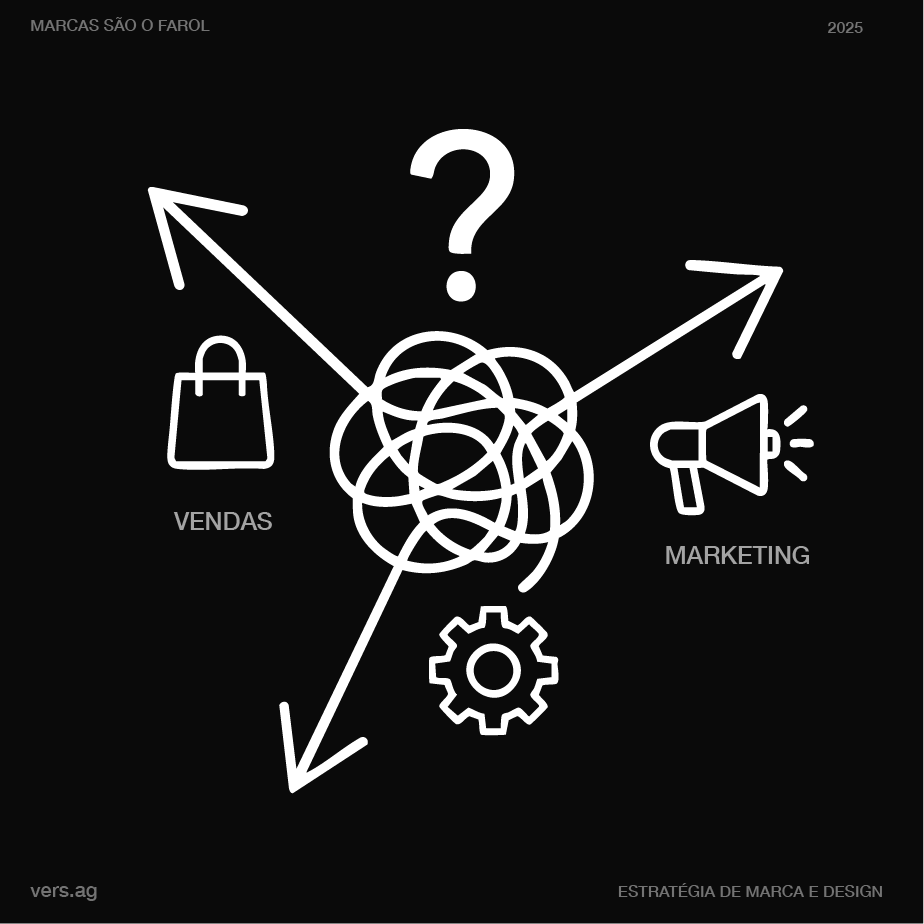
When a brand becomes just another boat at sea, the symptoms are clear and, for those who observe the corporate landscape, deeply revealing. It's not just a question of marketing or communication; it's a systemic failure that erodes operational efficiency and the perception of value in the market.
It's common to see situations like:
- Sales teams, under pressure from aggressive targets, resort to significant discounts, promising value that the organization may not be able to sustain consistently. At the same time, the marketing team invests substantially in campaigns to build a premium brand image, focused on innovation and exclusivity. This dissonance creates a fundamental tension: one sector devalues what the other is trying to value, generating internal and external confusion.
- The product team, seeking to meet market demands or follow trends, launches a new feature or service that, although technically impressive, seems out of line with the company's original promise. Long-time customers may ask: "Is this the same company I used to know?" New customers, meanwhile, are confused about what to expect from the brand.
- Communication on each channel - be it the website, social networks, customer service or emails - adopts a different "dialect". The brand's voice changes, the message contradicts itself, and the public, looking for clarity and trust, finds only noise and ambiguity.
This dissonance is not an isolated team management problem. It is a symptom of the absence of a central point of gravity, a guide that informs all decisions. It is the symptom of a brand that is adrift, without a beacon to guide its movements and messages.
The real cost of this inconsistency is commoditization. When an organization doesn't clearly know who it is and what it stands for, the market can't discern its unique value either. And when the market can't differentiate, the only metric left is price. The brand becomes interchangeable, and customer loyalty fragile. The company that once had its own light now competes in a sea of equals, where the only apparent advantage is being the cheapest. And, as we have already seen, competing on price is a race to the bottom, where margin and value are constantly eroded.
Purpose as a Management Tool: The Lighthouse in Action
If inconsistency is the symptom of a brand adrift, purpose emerges as the beacon that brings it back on course. It's not an abstract concept or a merely decorative phrase for the corporate website. It is, in fact, a practical and powerful management tool, an essential filter for every strategic decision an organization needs to make.
A clear, authentic and well-communicated purpose acts as a true operating system for the entire corporate structure. It answers the fundamental question: "Why do we exist?" And in doing so, it offers a non-negotiable criterion for evaluating every action, every investment, every interaction that the brand establishes.
You can see how purpose manifests itself as a beacon in different areas of a company:
- In Product and InnovationRather than following passing trends or launching features just because the competition does, purpose drives reflection: "Does this new feature bring us closer to or further away from our purpose of, for example, 'simplifying the customer's life' or 'unlocking creative potential'?" If the answer is "away", the decision becomes clear. Purpose ensures that innovation is targeted and meaningful, not just a reaction to the market.
- In Marketing and CommunicationPurpose has the power to transform communication from a mere "features" ad into an engaging and resonant narrative. The question is: "Does this campaign communicate the 'why' of our existence or does it just shout out our 'features'?" Brands with purpose don't just sell products; they sell the belief, the impact, the transformation that their purpose offers. This establishes a deep emotional connection with the public, which is much more resistant to market fluctuations and crises.
- In Sales and Customer RelationsPurpose takes the sales conversation to the next level. Instead of focusing exclusively on "being the cheapest" or "having the most features", sales teams can articulate: "How can we sell in a way that reinforces our promise of 'being the most trusted partner' or 'empowering our customers to achieve their dreams'?" The purpose inspires teams to look for solutions that really add value, building lasting relationships and reducing dependence on the price war.
- In HR and Internal CulturePurpose acts as a magnet to attract talent and as a cement to strengthen the organizational culture. The question in the hiring process becomes: "Does this candidate resonate with the values that underpin our purpose?" And internally, "Do our policies and work environment reflect the 'why' of our existence?" A team aligned with purpose tends to be more engaged, productive and resilient, because everyone is working for something bigger than just a paycheck.
In essence, purpose transcends the sphere of an inspiring idea and establishes itself as a company's main criterion for alignment and decision-making. It eliminates inconsistency, unifies teams and directs everyone's energy towards a common and meaningful goal. It is the light that ensures that each boat in a fleet sails in the same direction, in search of its own lighthouse.
Let Your Light Shine
In the vast and challenging ocean of the market, the choice facing organizations is clear: be just another boat adrift, competing in a sea of equals and vulnerable to storms, or establish yourself as a beacon, an unshakeable reference point that guides and attracts. The difference between one and the other lies not in the size of the fleet or the speed of the engines, but in the clarity and strength of the light that emanates.
A clear purpose that is lived throughout the organization is what truly transforms a company. It transcends the realm of an ideal and manifests itself as a powerful management tool, capable of eliminating inconsistency, aligning teams, driving innovation and, fundamentally, avoiding commoditization. It's what allows a brand to build real value that resonates with customers, engages employees and stands out in any scenario.
Building a lighthouse brand is not a question of having the biggest marketing budget, but of having the clearest identity. It's about knowing why you exist and translating that "why" into every action, every product, every interaction. It's about allowing an organization's intrinsic light to shine so brightly that it becomes an indispensable guide for all who seek what it offers.
Is Your Brand Ready to Be a Beacon?
Building a lighthouse requires more than a good light bulb; it requires a solid foundation, well-planned architecture and constant maintenance. If a brand feels it has the potential to be an unshakeable reference point in its market, but needs help to build that structure, to find and amplify its unique light, Vers specializes in designing and building brands that guide.
We help leaders and their teams discover their purpose, turn it into a cohesive brand strategy and implement it at every layer of the organization, ensuring that their light not only shines, but also guides.

 EN
EN  PT
PT  ES
ES